Internal Promotion vs External Move: How to Make the Right Call
Updated: 21 minutes ago
You can be good at your job, well regarded, and still feel completely uncertain when the next career decision arrives. The internal promotion vs external move question is rarely just about title or salary. It is usually about fit, timing, visibility, and whether your next step will actually make better use of what you do best.
What makes this harder is the assumption embedded in most career advice. That the right move is always upward. That progress means more seniority, more people, more responsibility. Build a decision on that assumption alone and you may find yourself somewhere you never actually wanted to be.
Not every meaningful career move is a promotion. Some professionals make a deliberate sideways step to recover, recalibrate, or move closer to work that suits them better. That is a legitimate choice, and sometimes the more strategic one. But for most mid-career professionals facing a genuine fork in the road, the real question is this: is it better to move up where you are, or move on somewhere else?

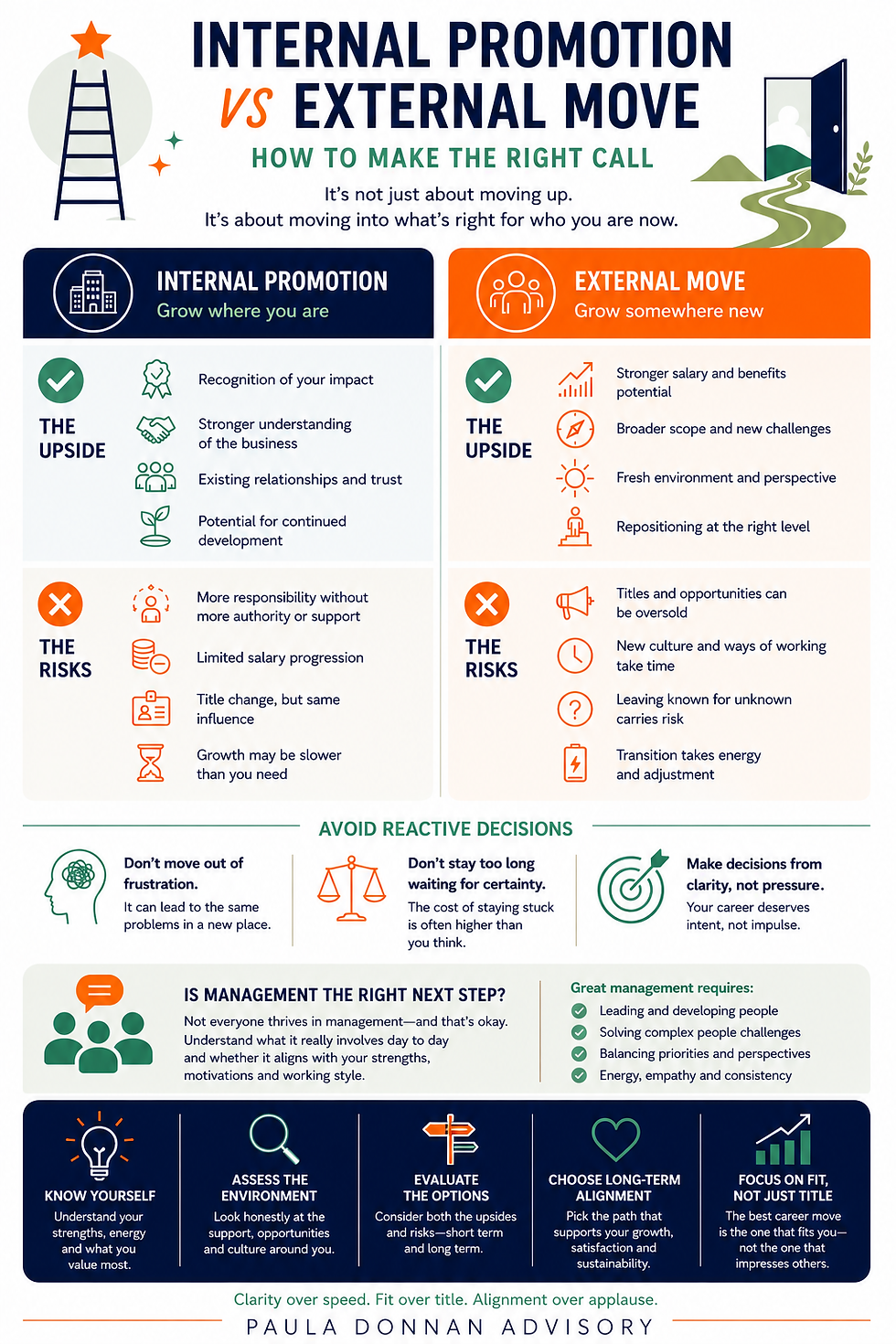
When an internal promotion is the right move
An internal promotion can be the right call when your organisation already sees your value and has a genuine path for you. Not vague encouragement, but clear evidence that the business is willing to invest in your development.
This route works well when your strengths are already visible, your manager advocates for you, and the next role builds naturally on what you do well. You spend less time proving basic credibility and more time delivering at a higher level. For professionals who do their best work when they understand the political landscape, the history, and the unwritten rules, staying can be a real advantage.
That said, opportunities for internal progression are less common than most professionals assume. According to LinkedIn’s 2024 Workplace Learning Report, only one in five employees has strong confidence in their ability to make an internal move. Only 33% of organisations have formal internal mobility programmes in place. In practice, the internal path can be narrower than it looks from the outside.
Internal promotion is also not always as developmental as it sounds. Sometimes the title changes but the authority does not. Sometimes pay lags behind market value. Sometimes the organisation promotes you because you are reliable, then expects you to carry a larger remit without changing the support or conditions around you.
If your responsibilities grow but your influence, reward, or backing do not, the promotion may create more strain than progress.

When an external move is the better decision
An external move tends to make sense when your current environment cannot stretch with you. This often shows up gradually. You are delivering consistently but not being considered for bigger opportunities. You are known for one thing and kept there. Others still relate to an earlier version of you, and that version no longer reflects where you are.
Staying in that situation can slowly erode confidence. Not because you are incapable, but because the environment has stopped reflecting your current level. A well-chosen external move can correct that. It can place you in a role that matches who you are now, not who others have got used to seeing.
External moves also tend to offer stronger leverage on pay and scope. Research supports this pattern. According to PwC’s 2024 Global Workforce Hopes and Fears Survey, 28% of professionals said they were likely to switch employers within the next twelve months. Of those, 67% pointed to a lack of opportunity to grow or develop new skills in their current role as the primary reason. People are not leaving because something better has landed in their inbox. They are leaving because the environment they are in has stopped investing in them.
The trade-off is real uncertainty. You may gain a better title, then discover the culture is poorly led or the role has been oversold. This is why external moves require more than optimism. They require careful, honest due diligence before you commit.

The problem with reactive decisions
One of the most common mistakes mid-career professionals make is moving reactively. Not toward something well considered, but away from something uncomfortable. Frustration, resentment at being passed over, or simple exhaustion can all push people toward a leap they have not thought through properly.
The result is often moving into a role they may no longer love, or taking on a level of responsibility they are not yet ready for. If the timing is wrong, it can set them back. Worse, it can quietly confirm the doubt that was already there. A move made from pressure rather than clarity rarely lands where it needs to.
But there is an equally costly mistake on the other side. With fewer internal promotions available and a more cautious external hiring environment, many mid-career professionals find themselves stuck in roles that no longer stretch or satisfy them. Rather than act, they wait. They hold out for the perfect job description, the promotion that keeps being deferred, or a market recovery that may not arrive in the form they expect. In doing so, they miss opportunities that exist right now, often in adjacent roles, different sectors, or smaller organisations that would value their experience more highly.
Waiting is not a neutral position. In a stagnant market, it carries a real cost. The honest question to sit with is not only whether you are ready to move, but whether staying is quietly costing you more than you have calculated. The answer changes the decision significantly.

The management question
There is a broader conversation worth naming. Not every professional should be moving toward management. And not every promotion that involves managing people is the right next step.
A growing number of mid-career professionals are making a deliberate choice to step away from or avoid the management route entirely. They are performing at a high level, contributing meaningfully, and protecting something important to them. That is not a failure of ambition. It is a clearer kind of self-knowledge. And it deserves far more respect than it typically receives.
There is also an interesting pattern worth noting. Some professionals find that formal management feels daunting, while leading something of their own does not. The accountability is different. The shape of the work is different. The distinction between formal management and other forms of leadership is real, and professionals are increasingly making that distinction for themselves.
Management changes everything. It changes what your days look like, which skills matter, and what you are held accountable for. Some professionals thrive in that environment. Others find it pulls them away from the kind of work that uses their strengths most naturally. If demanding work takes things from you, the question is whether what it takes is something you can afford to give.
Some professionals also take promotions not because they genuinely want them, but because they feel they should. The role is offered. Saying no seems risky. They accept under quiet pressure. That rarely ends well for anyone. The best decision around management is always the honest one, not the obligatory one.
How to assess any opportunity properly
Regardless of which direction you are considering, the same core question applies. Ask what the role will actually require from you week to week. Will you be working in areas that draw on your natural strengths, or spending most of your energy compensating for areas where you are less effective? Will success energise you or deplete you over time?
A more useful test than asking whether this is a good role is asking whether it is a good role for you, right now, at this stage of your career.
If you are leaning toward an internal promotion, ask direct questions. What does success look like in the first year? What authority comes with the role? How will your performance be measured? What support will be available as responsibilities increase? A credible promotion should come with clear expectations, not just goodwill and a new job title.
Pay attention to whether leaders answer your questions clearly or vaguely. Vagueness at the offer stage tends to persist long after you have accepted.
If you are looking externally, look just as carefully at whether the environment deserves you. Ask how decisions are made, what the team is inheriting, where previous post-holders found it most difficult, and what the leadership culture is like day to day. Strong organisations can explain the real context of a role honestly. Weaker ones tend to sell aspiration and hide what is actually going on.

How to Approach the Decision Making Process
Making a thoughtful decision between an internal promotion and an external move involves gathering information, reflecting on your values, and seeking advice. Here are practical steps to guide you.
1. Assess Your Current Organisation’s Promotion Culture
Look at the track record of internal promotions within your company. How many senior leaders have risen through the ranks? Does the organisation invest in leadership development programmes? If your company has a history of favouring external hires for senior roles, that is a signal that internal growth may be limited. Conversely, a culture that visibly promotes from within suggests that your loyalty could be rewarded over time.
2. Evaluate the Specific Opportunity
Whether the opening is internal or external, evaluate it on its own merits. Consider the responsibilities, the team you would lead, the resources available, and the alignment with your long-term career goals. A senior professional should not accept a promotion simply because it is offered; it must genuinely enhance your career arc. Similarly, an external offer should be weighed against the total compensation package, the company’s stability, and the cultural fit.
Frequently Asked Questions
Is it always better to take an internal promotion than to leave for a new job?
Not always. An internal promotion offers stability and a shorter learning curve, but it rarely comes with the same financial rewards as an external move. If your current organisation cannot offer competitive compensation or the role does not stretch you, an external move may provide better long-term growth opportunities.
Why do some companies prefer to hire externally instead of promoting from within?
Companies sometimes prefer external hires to bring in fresh perspectives and new skills that internal candidates may lack. External hires can also disrupt groupthink and introduce innovative practices. However, this approach can demotivate existing staff and increase turnover if it becomes a pattern.
How can I increase my chances of being promoted internally?
To increase your chances, make your career ambitions visible to decision-makers. Build strong relationships with senior leaders, seek mentorship, and demonstrate readiness for greater responsibility. Taking on stretch assignments and expanding your network within the organisation can also position you as a natural candidate when a promotion arises.
What should I consider before making a lateral internal move?
A lateral move can broaden your experience without changing employer. Consider whether the new role aligns with your long-term goals, whether it offers new challenges, and how it will affect your compensation. Lateral moves are often undervalued but can be a strategic way to gain cross-functional skills and increase your value to the organisation.
If I am offered an internal promotion but the salary is below market rate, should I negotiate?
Yes, you should negotiate. Use market data from your research or from external job offers to make a case for a higher salary. Employers may have flexibility within their pay bands, and advocating for yourself professionally is expected. If the organisation refuses to match market rates, that may be a signal that your future earning potential is limited there.
Choosing between an internal promotion and an external move is one of the most consequential career decisions a senior professional can make. By weighing the financial implications, the learning curve, the cultural fit, and your own aspirations, you can select the path that not only advances your career but also sustains your sense of purpose and professional fulfilment. Whether you decide to progress within your current organisation or embark on a new adventure elsewhere, the key is to make the choice with clarity and confidence.

Clarity matters more than speed
If you are torn, the aim is not to make the most impressive choice. It is to make the most aligned one.
Good decisions are built on evidence. Evidence about your strengths, your current readiness, the quality of the opportunity, and the reality of the environment you would be stepping into. When you assess both options at that level of honesty, one route usually becomes clearer. Not dramatically so, but more credible, more sustainable, and more likely to help you do your best work.
A career step should not only look like progress. It should feel like a better fit for who you are now, not who others have got used to seeing. If you decide to stay and go for the role internally, my piece on why being indispensable can hold back an internal promotion looks at how to make your readiness easy to see.
If you are finding it difficult to assess your options clearly, a structured conversation can help. A career consultation with Paula Donnan Advisory gives you the space to identify what is creating friction, where your strengths are being underused, and what a better-aligned next step looks like for you.
Book a career consultation: www.pauladonnanadvisory.com/product-page/career-consultation-belfast
By Paula Donnan
Strength-Led Career Consultant
Looking for your next management or executive role in the UK or Ireland? Click here.
Strength at Work | Better judgement. Stronger leadership. Higher performance.


Comments